Why Training at Long Muscle Lengths Builds More Muscle
For years, the standard advice in bodybuilding was simple: if you want to grow, you need a full range of motion. Lifters were told to chase the “peak contraction”—that hard squeeze at the top of a bicep curl or a chest fly—as if their gains depended on it.
But what if the most important part of the lift isn’t the squeeze at all? What if it’s the part most lifters rush through?
Dr. Milo Wolf, a researcher in exercise science, recently shared how a deep dive into the data forced him to change his mind. Here’s why training at long muscle lengths is the new frontier of hypertrophy—and how you can use it to build more muscle.
From “Full ROM” to Stretch-Focused Training
Most lifters fall into one of two camps: the Full Range of Motion (ROM) purists or the partial rep crowd. For a long time, Dr. Wolf was firmly in the “full ROM” camp. He believed that the squeeze was just as vital as the stretch.
However, while conducting a meta-analysis (a study that pools data from many individual studies) during his PhD, he discovered a clear pattern: the more a muscle is trained in a stretched position, the more it grows.
The Evidence: Stretch vs. Squeeze
When researchers compared different types of training, the results were striking:
- Full ROM vs. partials: Generally, full ROM produces better results than partial reps.
- The lengthened advantage: Partial reps performed in the stretched (lengthened) position often outperform both full ROM and shortened partials for muscle growth.
- The bicep case study: In a study by Henson et al., lifters who focused only on stretch-emphasized exercises saw equal or better growth compared to those who split their time between stretching and squeezing exercises.
How to Apply Stretch-Focused Training
You don’t have to overhaul your entire routine. These targeted shifts can produce meaningful differences in your results.
1. Prioritize the Bottom of the Lift
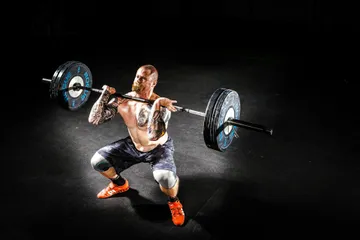
On exercises like the chest press, overhead triceps extensions, or squats, the “bottom” is where the muscle is most stretched. Instead of bouncing out of the bottom to get back to the easy part, stay controlled and maintain tension in that deep position.
SetsApart tip: Track your progressive overload on stretch-biased exercises separately. If your incline dumbbell curls are getting stronger over time, your biceps are getting the growth stimulus they need.
2. Try Lengthened Partials
When you reach technical failure and can no longer complete a full rep, don’t just rack the weight. Dr. Wolf suggests doing past-failure partials in the stretch position. For example, on a lat pulldown or a leg curl, continue doing partial reps in the bottom portion of the movement where the muscle is stretched until you can’t move the weight at all.
This technique adds extra stimulus precisely where it matters most for hypertrophy.
3. Choose Stretch-Biased Exercises
Some exercises are naturally better at loading the stretch than others:
- Incline dumbbell curls: Put the bicep in a deeper stretch than a standard standing curl.
- Overhead triceps extensions: Stretch the long head of the triceps more than cable pushdowns.
- Deep squats and RDLs: Maximize the stretch on glutes and hamstrings.
When building your program, prioritize at least one stretch-biased exercise per muscle group. For guidance on exercise selection, see our guide on the best exercises to build muscle.
4. Track Your Stretch-Biased Hard Sets
With SetsApart, you can monitor your hard sets on stretch-biased exercises and ensure you’re hitting sufficient weekly volume. The Volume Per Muscle Group feature shows whether each muscle is getting enough stimulus—especially important when you’re shifting exercise selection toward lengthened movements.
Update Your Training Based on the Evidence
The most important takeaway from Dr. Wolf’s research isn’t just about exercise selection—it’s about being willing to update your approach when new data emerges. Research on stretch-mediated hypertrophy has grown substantially in recent years, and the evidence consistently points in the same direction: training at long muscle lengths produces superior growth.
If the data shows that emphasizing the stretch leads to better hypertrophy, it’s worth adjusting your exercise selection and rep technique accordingly. For more on how to structure your training around the latest science, check out our science-backed workout guide.
Key Takeaways
- Prioritize the stretched position: The bottom of the movement is often the most productive for growth.
- Control the eccentric: Ensure you’re reaching a deep, loaded stretch on every rep.
- Use lengthened partials: When you can’t complete more full reps, finish the set with partials in the stretched position.
- Choose stretch-biased exercises: Incline curls, overhead extensions, deep squats, and RDLs load the muscle where it matters most.
Source
This article was inspired by and summarizes key insights from the following video. Check out the video for more detail and subscribe to the channel—it’s a great resource for evidence-based training.
Watch the full video: I Was Wrong About the Stretch - Here’s Why